Thanzi Visual Abstract – Rao – Insights from financial economics to value healthcare investments that reduce systemic risks.pptx

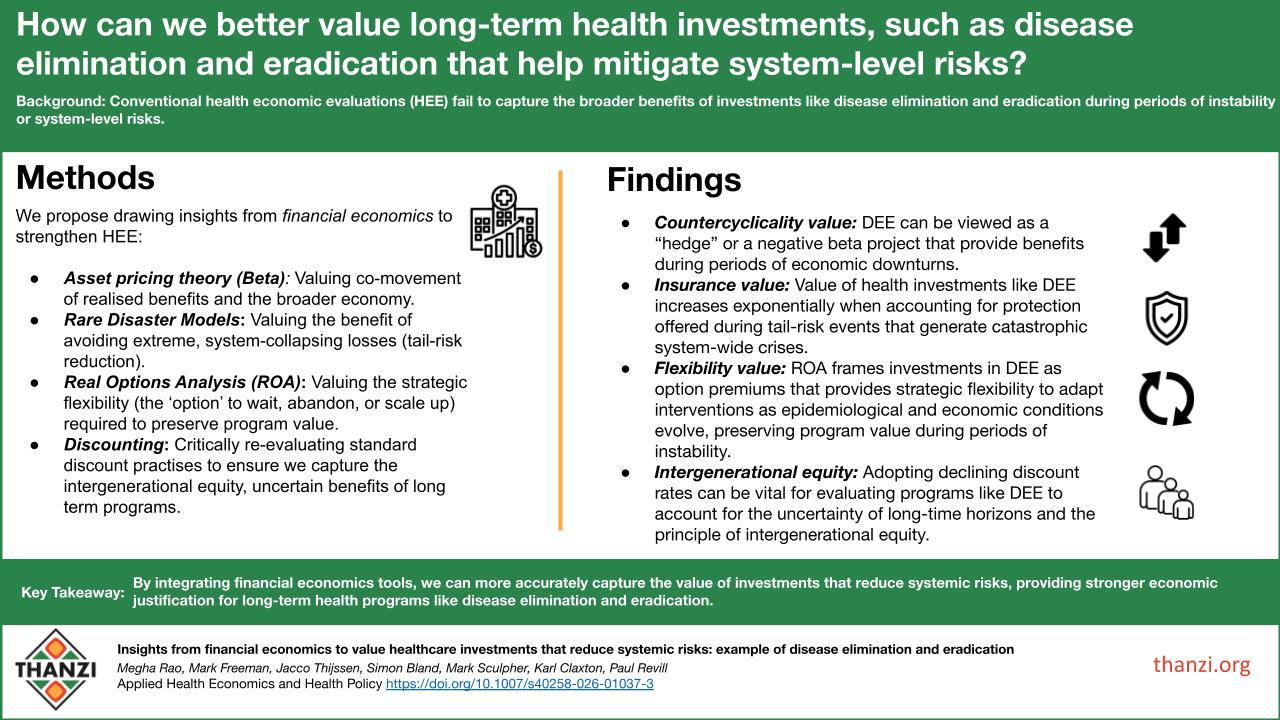
Headline: Insights from financial economics to value healthcare investments that reduce systemic risks: example of disease elimination and eradication. Overview: This visual abstract outlines how tools from financial economics can better value long-term health investments like disease elimination and eradication (DEE), which conventional evaluations often undervalue. Core Content: The Problem: Conventional health economic evaluations (HEE) fail to capture the broad benefits of DEE during periods of system-level risk or instability. Proposed Methods: The authors suggest drawing from four financial economics concepts: Asset Pricing Theory (Beta): Valuing how realized benefits move in relation to the broader economy. Rare Disaster Models: Valuing the avoidance of extreme, system-collapsing "tail-risk" losses. Real Options Analysis (ROA): Valuing strategic flexibility to wait, abandon, or scale programs to preserve value. Discounting: Re-evaluating discount practices to account for intergenerational equity and long-term uncertainty. Key Findings:Countercyclicality Value: DEE acts as a "hedge" (negative beta) by providing benefits during economic downturns. Insurance Value: The value of health investments increases exponentially when protecting against catastrophic, system-wide crises. Flexibility Value: ROA treats DEE investments as "option premiums" that allow programs to adapt as conditions evolve. Intergenerational Equity: Declining discount rates help account for long-time horizons and fairness to future generations. Key Takeaway: Integrating these financial tools provides a stronger economic justification for long-term health programs by more accurately capturing their value in reducing systemic risks.